





 PDF Links
 PubReader
 XML Download
 Full text via DOI
 Download Citation
 |
 |
| J Korean Med Assoc > Volume 49(6); 2006 > Article |
Abstract
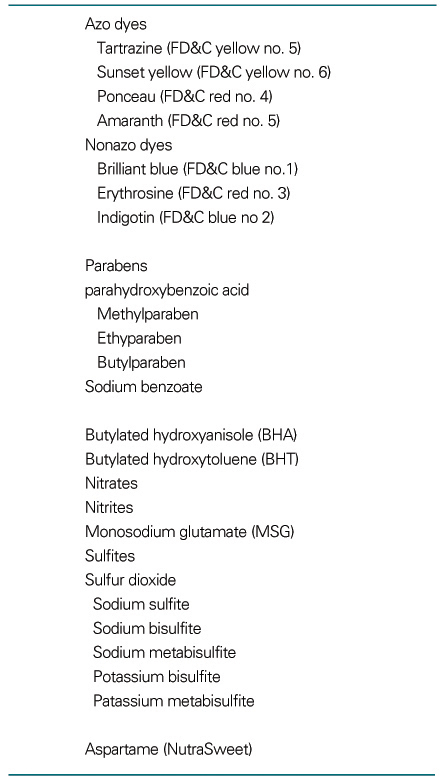
Many different additives are added to the food that we consume, and the number of additives is estimated to range from 2,000 to 20,000. These substances include preservatives, stabilizers, conditioners, thickeners, colorings, flavorings, sweeteners, and antioxidants. Despite the multitude of additives known, only a surprisingly small proportion of them has been associated with hypersensitivity reactions. A number of investigators have suggested that a significant proportion of patients with chronic urticaria, angioedema, atopic dermatitis, and asthma have symptoms related to the ingestion of food additives. However, the incidence and mechanisms of reactions to additives in patients with chronic urticaria, angioedema, and atopic dermatitis remain unknown. Monosodium glutamate(MSG) produces the flavor-enhancing properties of seaweed, the traditional component of Japanese and Chinese cooking. A few studies on MSG have reported an association between MSG and atopic dermatitis, but the exact nature of the relationship remains unknown. Dyes approved under the Food Dye and Coloring Act are coal tar derivatives, the best known of which is tartrazine(FD&C yellow no. 5). The group of azo dyes includes ponceau(FD&C red no. 4) and sunset yellow (FD&C yellow no. 6). Amaranth(FD&C red no. 5) was banned from use in US in 1975 due to the claims related to carcinogenicity. Most of them were reported to be associated with an aggravation of atopic dermatitis. Parabens are aliphatic esters of parahydroxybenzoic acid. Sodium benzoate is a closely related substance usually reported to cross-react with these compounds. These agents, which are widely used as preservatives in both foods and drugs, are well recognized as the cause of severe contact dermatitis. Additives can serve as haptens to create a response mediated by IgE. Only a few reports have suggested IgE-mediated reactions, notably to sulfites and parabens. Instead, the overwhelming majority of these reactions are not of the immediate hypersensitivity type. Many cases of additive-provoked urticaria or dermatitis occur as late as 24 hours after the challenge,arguing against an IgE-mediated mechanism.
References
1. Joint FAO/WHO. Safety evaluation of certain food additives and contaminants. WHO food additives Series on INCHEM 2001;49:1021-1024.
2. Joint FAO/WHO food standards programme CODEX alimentarius commission. Alinorm 2006.
3. Sporik R, Holgate ST, Platts-Mills TA, Cogswell SS. Exposure to house-dust mite allergen (Der p I) and the development of asthma in childhood: a prospective study. N Engl J Med 1990;323:502-507.
4. Barnes RMR. In: Kay AB, editor. Principles and interpretation of laboratory tests for allergy. Allergy and Allergic Diseases 1997;Oxford: Blackwell Science Ltd.. 997-1005.
5. Boguniewicz M, Leung DYM. In: Adkinson NF, Bochner BS, Yunginger JW, Holgate ST, Busse WW, Simons FER, editor. Atopic dermatitis. Middleton's allergy: principle and practice 2003;St. Louise: Mosby. 1559-1580.
6. Leung DYM. In: Leung DYM, Sampson HA, Geha RS, Szefler SJ, editor. Atopic dermatitis. Pediatric Allergy: principle and practice 2003;St Louise: Mosby. 561-573.
7. Brostoff J, Challacombe SJ. Food allergy and intolerance 2002;2nd ed. St. Louis: Saunders.
9. Scott HS, Anne MF, Ramon M, Robert AW. Symposium: Pediatric food allergy. Pediatrics 2003;111:1591-1671.
10. Shideh M. Nutritional management of pediatric food hypersensitivity. Pediatrics 2003;111:1645-1653.
14. Ikeda K. On the taste of the salt of glutamic acid (new seasoning). J Tokyo Chem Soc 1909;820-836.
15. Gianocometi T. In: Filer LJ, Garattini S, Kare MR, Reynolds WA, Wurtman RJ, editor. Free and bound glutamate in natural products. Glutamic acid: advances in biochemistry and physiology 1979;New York: Raven Press. 25-34.
16. Ghadimi H, Kumar S, Abaci F. Studies on monosodium glutamate ingestion. I. Biochemical explanation of Chinese restaurant syndrome. Biochemical Med 1971;5:447-456.
17. Botey J, Cozzo M, Marin A, Eseverri JL. Monosodium glutamate and skin pathology in pediatric allergology. Allergol Immunopathol 1988;16:425-428.
18. Speer K. The management of childhood asthma 1958;Springfield IL: Charles C. Thomas. 23-40.
19. Lockey SD. Allergic reactions due to FD and C yellow #5 tartrazine, an aniline dye used as a coloring agent in various steroids. Ann Allergy 1959;17:719-725.
20. Simon RA. Adverse reactions to drug additives. J Allergy Clin Immunol 1984;74:623-630.
21. Devlin J, David TJ. Tartrazine in atopic dermatitis. Arch Dis Child 1992;67:709-711.
22. Williams AE. Benzoic acid. Kirk-Othermer Encyclopedia of Chemical Technology 1978;3rd ed. New York: Wiley-Interscience. 778-792.
23. Lueck E. Anmicrobial food additives 1980;New York: Springer-Verlag.
24. Juhlin L. Incidence of intolerance to food additives. Int J Dermatol 1980;19:548-551.
25. Nettis E, Colanardi MC, Ferrannini A, Tursi A. Sodium benzoate-induced repeated episodes of acute urticaria/angio-oedema: randomized controlled trial. Br J Dermatol 2004;151:898-902.
26. van Bever HP, Docx M, Stevens WJ. Food and food additives in severe atopic dermatitis. Allergy 1989;44:588-594.
27. Österballe O, Taudoroff E, Haahr J. Intolerance to aspirin, food-colouring agents and food preservatives in childhood asthma. Ugeskr Laeger 1979;141:1908-1910.
- TOOLS
-
- Share :
-





-
METRICS

-
- 0 Crossref
- Scopus
- 1,219 View
- 2 Download
-

-
Related articles in
J Korean Med Assoc -
Orthopedic disease and sports medicine in shoulder joint2011 July;54(7)
- Editorial Office
-
37 Ichon-ro 46-gil, Yongsan-gu, Seoul
Tel: +82-2-6350-6562 Fax: +82-2-792-5208 E-mail: jkmamaster@gmail.com
Copyright © 2024 by Korean Medical Association.
