




 PDF Links
 PubReader
 XML Download
 Full text via DOI
 Download Citation
 |
 |
| J Korean Med Assoc > Volume 47(4); 2004 > Article |
Abstract
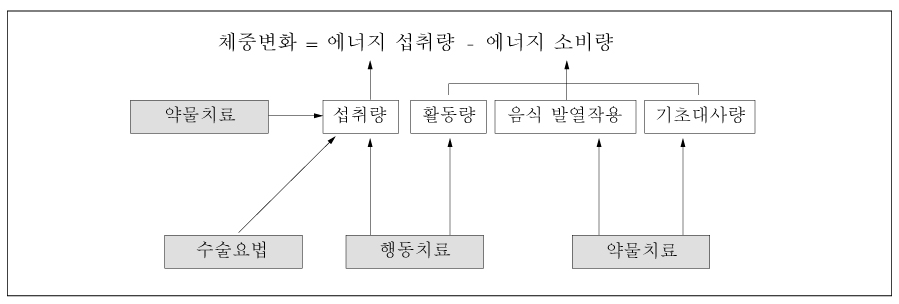
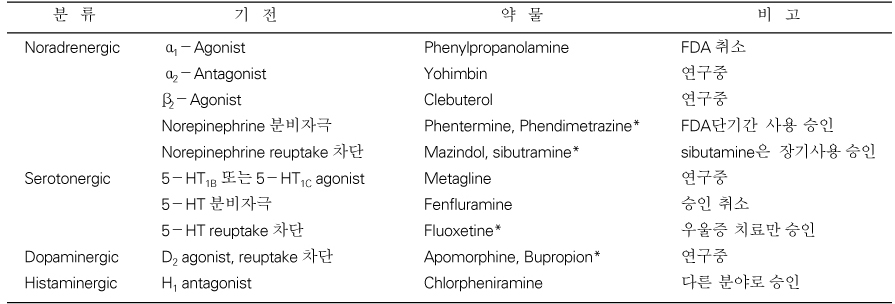
Obesity is a major global health problem. However, current therapeutic strategies for obesity are limited. Obesity results from an imbalance between energy intake and energy expenditure, and the treatment of obesity is based on the correction of this metabolic imbalance. Anti-obesity drugs can shift this balance in a favorable way by reducing food intake, altering metabolism, and by increasing energy expenditure. There is a growing consensus that pharmacotherapy is appropriate for many individuals who are unable to lose weight through less intensive measures. However, side effects may ensue phamacotherapy for obesity. Only two drugs (sibutramine and orlistat) are currently approved for the long-term treatment of obesity. Sibutramine inhibits the reuptake of serotonin and norepinephrine. Orlistat works by blocking the pancreatic lipase. However, phamarcotherapy may not be the ultimate resolution for obesity management. Because the underlying pathophysiology in each individual varies in many aspects, it is recommended to provide individualized and tailored medication in addition to other anti-obesity supportive treatments.
References
2. Peter G, Kopelman , Michael J. Stock. Clinical Obesity "Drug treatment of obesity: General Principles and Current Therapies 1999;Blackwell Science press. 469-507.
3. Levine LR, Enas GG. Use of Fluoxetine, a serotonergic dreg for obesity control. Obesity in Europe 1988;319-321.
4. Glazer G. Long-term phamacotherapy of obesity 2000: a review of efficacy and safety. Arch Intern Med 2001;161:1814-1824.
5. Food and Drug Administration. Guidance for the clinical evaluation for weight control drugs 1996;Rockville.
- TOOLS
-
- Share :
-





-
METRICS

-
- 3 Crossref
- Scopus
- 1,172 View
- 5 Download
-

-
Related articles in
J Korean Med Assoc -
Medical treatment of pediatric obesity2024 May;67(5)
Current status and treatment of obesity in Korea2022 December;65(12)
Surgical treatment for obesity2022 July;65(7)
Pharmacologic treatment of obesity2022 July;65(7)
Treatment of heart failure with reduced ejection fraction2022 January;65(1)
- Editorial Office
-
37 Ichon-ro 46-gil, Yongsan-gu, Seoul
Tel: +82-2-6350-6562 Fax: +82-2-792-5208 E-mail: jkmamaster@gmail.com
Copyright © 2024 by Korean Medical Association.
